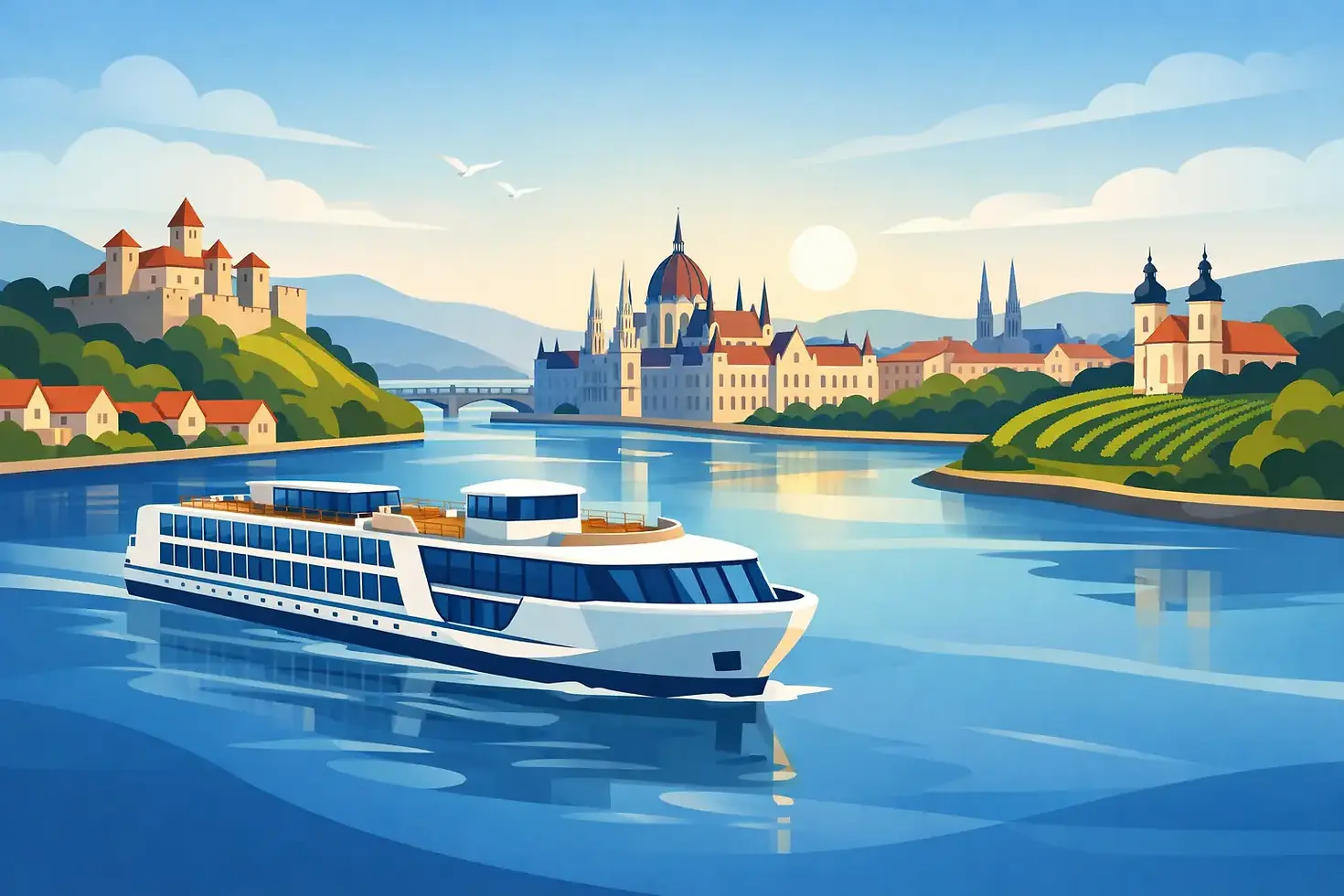
A Danube Cruise Itinerary Example for 10 Nights
The finest Danube journeys are not measured by how many capitals appear on the schedule, but by how comfortably each one can be experienced. This Danube cruise itinerary example allows time for Budapest’s grandeur, Vienna’s cultural rhythm and the vineyard-lined Wachau Valley, while preserving the unhurried pleasure that makes river cruising so distinctive.
Designed as a ten-night holiday, it combines two nights in Budapest before embarkation, a seven-night luxury river cruise to Vilshofen, and one restorative night in Munich. It is an excellent shape for first-time Danube cruisers who want the major highlights without treating Central Europe as a checklist.
A 10-night Danube cruise itinerary example
This westbound route begins in Budapest and concludes in southern Germany. It works particularly well for travellers who appreciate an elegant progression: imperial Hungary, Slovakia’s compact capital, Vienna’s artistic splendour, Austria’s pastoral heartland and Bavaria’s historic towns.
The precise port times, included tours and dining arrangements will vary by ship. That distinction matters. A smaller, more polished vessel may remain in a particularly central berth, while another may offer a broader choice of active excursions or a more expansive wellness offering. The itinerary is the frame; the right ship determines how it feels.
Nights 1 and 2: Budapest at a considered pace
Arrive in Budapest and settle into a well-located hotel on either the Pest side, near the grand boulevards and cafés, or the more residential Buda side beneath Castle Hill. A private arrival transfer is a small detail with considerable value after an overnight flight, particularly when luggage, early check-in and a first lunch reservation are all handled in advance.
Use the first afternoon simply to orientate yourself. A gentle walk along the Danube promenade reveals the Parliament building, Chain Bridge and the opposing sweep of Buda Castle. In the evening, choose a refined Hungarian restaurant rather than an ambitious sightseeing plan. The city deserves a fresh eye the following morning.
On the second day, a private guide can bring the city’s layered history into focus, from the neo-Gothic Parliament to the 19th-century grandeur of Andrássy Avenue. Those drawn to architecture may prefer a closer look at the Art Nouveau details of the Gresham Palace area. Others may choose a late afternoon visit to one of Budapest’s historic thermal baths. It depends on whether culture, restorative time or a little of both feels most fitting before the cruise begins.
Day 3: Embarkation and Budapest by water
After a relaxed breakfast and hotel check-out, transfer to the ship. Embarkation is usually in the afternoon, leaving time for a final coffee or a leisurely market visit if flight timing permits.
Sailing from Budapest is one of river cruising’s quietly dramatic moments. As dusk settles, the city’s illuminated Parliament and bridges recede behind the ship. Rather than rushing off for another activity, this is an evening to be on deck with a glass of wine and let the journey announce itself.
Day 4: Bratislava, small in scale and rich in character
Bratislava is refreshingly manageable after Budapest. Its pedestrian old town, with pastel façades, small squares and traces of Habsburg influence, lends itself to a guided walk without demanding a full day of exertion.
A standard city tour is often enough here, but travellers with particular interests can make the stop more personal. A food-focused walk introduces Slovak specialities in local settings, while a private excursion can reach Devin Castle, where the Danube meets the Morava River. The latter rewards those who enjoy landscape and history more than shopping streets.
By late afternoon, the ship continues towards Vienna. This is precisely the kind of interval that gives a river cruise its appeal: no unpacking, no coach transfer to a new hotel, and no need to decide where dinner will be.
Days 5 and 6: Vienna, with room to linger
Vienna benefits from an overnight stay, and not every Danube sailing includes one. It is worth seeking out. One full day can be devoted to the city’s imperial landmarks: Schönbrunn Palace, the Ringstrasse, St Stephen’s Cathedral and the stately avenues that once framed Habsburg power.
The following day should be less formal. Perhaps begin at the Kunsthistorisches Museum, linger in a traditional coffee house, then explore the MuseumsQuartier or the quieter lanes around the Spittelberg district. Music lovers may reserve seats for an evening concert, although programme quality and venue matter more than the promise of a generic ‘Viennese evening’.
There is a trade-off here. An intensive excursion to Schönbrunn, the city centre and a concert can be rewarding, but it can also leave little space to absorb Vienna’s atmosphere. For many mature travellers, a private guide for several hours, followed by independent time, provides a more gracious balance.
Day 7: Dürnstein and Melk in the Wachau Valley
The Wachau is the Danube at its most romantic: steep terraced vineyards, apricot orchards, ruined castles and villages gathered close to the riverbank. Morning may bring a call at Dürnstein, recognisable by the blue tower of its abbey church and associated with the legend of Richard the Lionheart’s captivity.
Active travellers can walk up to the castle ruins for broad river views. The path is rewarding but uneven, and a relaxed village stroll is every bit as appealing for those who prefer level ground. Later, Melk Abbey rises above the river with theatrical confidence. Its library, frescoed interiors and position over the valley make it one of the route’s defining visits.
This is an excellent day to choose an excursion with care. A bicycle ride through the Wachau is delightful in mild weather, while a wine tasting or scenic coach tour suits a slower pace. Neither is objectively better; comfort, mobility and the pleasure you take in being outdoors should guide the decision.
Day 8: Linz or Salzburg, according to your priorities
Ships commonly call at Linz, offering a choice between exploring this forward-looking Austrian city or travelling farther afield to Salzburg. Salzburg is compelling for Mozart, baroque architecture and the alpine setting, but it is a long day with substantial coach time.
For some, Salzburg is an essential bucket-list experience and entirely worth the journey. For others, a more leisurely day in Linz, perhaps with a visit to the hillside pilgrimage church of Pöstlingberg or time along the Danube, is the wiser luxury. A well-designed holiday leaves room to choose ease when ease is what you value.
Day 9: Passau and the meeting of three rivers
Passau sits at the confluence of the Danube, Inn and Ilz, with a handsome old town and the commanding St Stephen’s Cathedral. A guided walking tour reveals Italianate squares and baroque streets shaped by centuries of trade and renewal.
The cathedral’s organ recital, when available, offers a memorable pause from sightseeing. Passau is also a useful reminder that river cruising’s pleasures are often intimate rather than monumental: a narrow street, a riverside view, an unhurried lunch, and the ease of returning to a familiar cabin nearby.
Day 10: Vilshofen and onward to Munich
Disembark in Vilshofen and continue by arranged transfer to Munich for the final night. This buffer transforms a potentially tiring travel day into a gentle conclusion. Choose a central hotel, take an easy walk around Marienplatz and the Viktualienmarkt, and enjoy a final Bavarian dinner at a pace that suits you.
An overnight here is especially sensible when return flights depart early or when connections are not entirely straightforward. It removes the pressure of travelling from the ship directly to the airport and provides welcome protection against the small timing changes that can affect any journey.
Day 11: A calm departure
A pre-arranged transfer to Munich Airport allows the holiday to end as it began: without unnecessary decisions. For travellers continuing onward, Munich also offers excellent rail and air connections across Europe.
What makes this Danube cruise itinerary work
The route succeeds because it alternates capitals with smaller places and formal touring with time simply spent on the river. Budapest and Vienna supply the grandeur; Bratislava, Dürnstein and Passau offer a more human scale. The Wachau provides the visual stillness that many guests remember most clearly.
It is also a flexible blueprint. Those with more time might add two nights in Vienna after the cruise, particularly for opera, museums or a slower cultural stay. Travellers who prefer fewer hotel changes could omit Munich and arrange a departure transfer from Vilshofen, though that choice usually requires a more carefully timed flight.
The most successful version will reflect your preferred rhythm, cabin requirements, dining expectations and appetite for guided activity. At Sleeping Giant Travel Co., that is where specialist planning earns its place: shaping a storied waterway into a journey that feels composed, personal and entirely manageable.
Leave a little unscheduled time within the plan. On the Danube, the moments that stay with you are often not the ones printed in bold type, but a quiet coffee in Vienna, the view from a passing vineyard, or an unplanned hour on deck as Europe glides by.


Comments